Why I Got My WSET Level 2 – And What Wine Has to Do With My Photography
As a Cape Town wine photographer, my relationship with the industry goes deeper than just showing up with a camera.
Wine found me before I found it professionally. That probably sounds backwards, but it’s true.
It started more intentionally about three years ago with event coverage for Eenzaamheid – one of the Swartland’s most distinctive producers – twice a year for their wine festivals. Standing in that environment, watching people engage with wine that was made with genuine conviction, something clicked. This wasn’t just a client. This was a world I wanted to understand properly.
Since then I’ve been studying wine quietly on my own – reading, tasting, paying attention. The Cape Winelands are on my doorstep and I’ve never taken that lightly. So late last year I decided to formalise what I’d been accumulating and enrolled in the WSET Level 2 Award in Wines through Cathy Marston and the team at the International Wine Education Centre. I attended the course in early December with a good friend, still had the exam to write, and made the slightly questionable decision to study and sit it over the festive season. Distinction. Worth every sacrificed holiday afternoon.
The WSET Level 2 is an internationally recognised qualification covering grape varieties, wine regions, winemaking, and – my personal favourite part – the Systematic Approach to Tasting. It teaches you to taste with intention rather than just preference. For someone who photographs wine for a living, that’s not a small thing.
Wine Photography – Relating to my working world
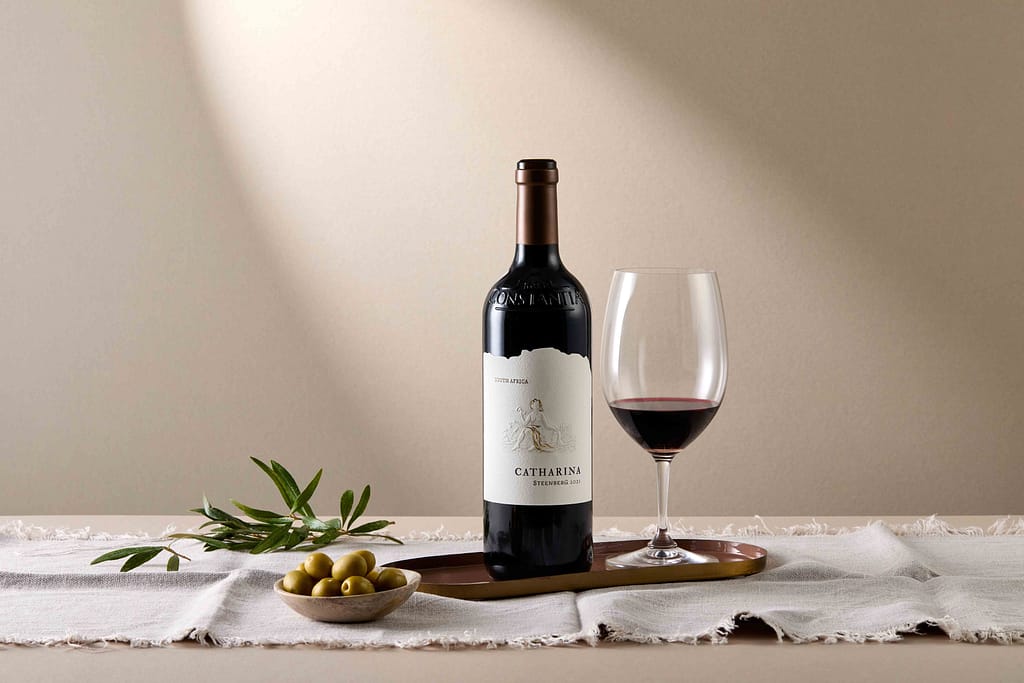
Here’s something I think about often on a wine shoot: a wine bottle is essentially a 360-degree mirror. It reflects everything in the room – the lights, the set, the photographer, the ceiling. Making it look clean and intentional rather than chaotic is a genuine technical challenge, and one I find deeply satisfying to solve. Understanding what’s inside the bottle – the variety, the region, the producer’s intention – changes how I approach telling its story visually.
That connection between knowledge and craft is exactly why the WSET felt right. I wasn’t studying wine to become a sommelier. I was studying it to become a better photographer of it – and honestly, because I really enjoy it.
Steenberg, Henk, and what collaboration actually looks like
A lot of my wine work happens in collaboration with Henk Hattingh, a food and commercial photographer who has been both a dear colleague and long-time mentor over the past four years. We shoot together for Steenberg – one of the Cape Peninsula’s most beautiful and storied wine farms – with styling by Lisa Perrin, who brings a considered, elegant hand to every setup that makes both our jobs better.
Working with Henk has taught me as much about discipline and craft as any course has – not without the regular jokes and inside stories that are so elemental to how we work together, iykyk. There’s something valuable about watching someone who has spent decades in this space make decisions on set: what to include, what to strip back, when the light is doing the work and when you’re fighting it. Wine photography at that level is slow, precise, and deeply satisfying when it lands.
If you’re a wine farm or beverage brand looking for a photographer who actually understands what’s in the bottle, you know where to find me.
What’s next
I run a separate Instagram account dedicated to my love of wine – @thetannintale – where I share tasting notes, cellar visits, and the occasional bottle that stops me in my tracks. If wine is your thing too, come find me there.
As for the WSET – Level 3 is on the horizon. But first, there’s work to shoot and wine to drink. Not necessarily in that order. 🍷